Protection and risk
Turn employees into a stronger line of defense
People are where most attacks start, and they are the part of your defense that no tool configures for you. The Spirity Cyber Awareness Platform measures how your workforce actually behaves, teaches the specific thing each person got wrong, and produces evidence your board and your auditor can each use.
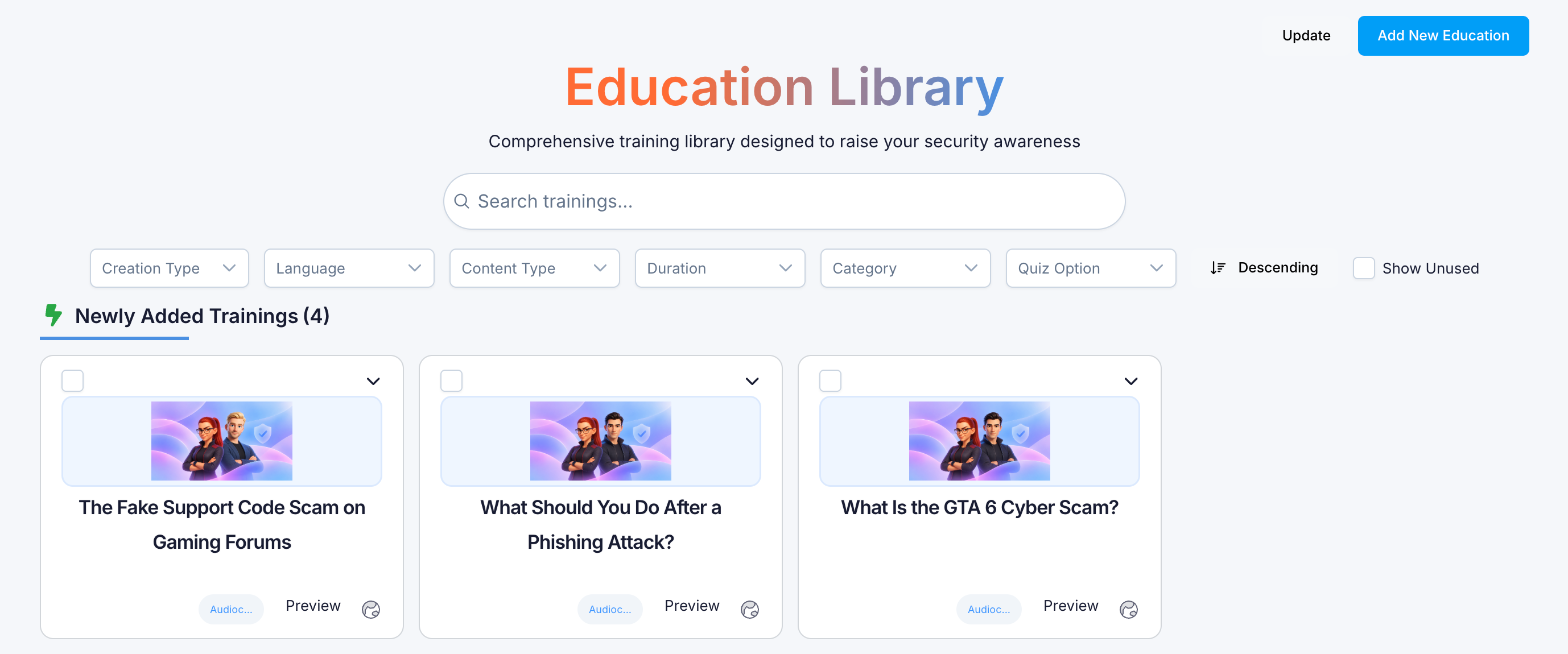
One platform, every channel attackers use
Phishing simulation
800+ email templates across six attack types, from a simple link click to multi-stage credential-and-malware chains.
SMS, voice and USB
Smishing, vishing, automated voice (IVR) and removable-media tests, for the attacks that never touch an inbox.
Training and curricula
700+ interactive modules, plus your own content in SCORM, video, PDF or slides, assembled into learning paths with deadlines and quizzes.
Content library
Newsletters, security tips, posters, screensavers and podcasts that keep the subject alive between campaigns.
Policy acknowledgement
Send a policy, collect a dated acceptance from every named person, and attach training before or after it.
Reporting and evidence
A score per person, team and department; management reports you can shape; scheduled scorecards; and exports an auditor can trace line by line.
Run it yourself, or hand us the program
The platform is the same either way. What differs is who plans the campaigns, writes the scenarios and reads the results each month.
Both options include
- Full platform access
- Platform training for your administrators
- Regular support from our team
- New content as we produce it, in every language you use
- Priced per employee, over twelve months
Cyber Awareness Platform
Teams with someone who wants to own the program.
- You plan and run the campaigns
- You choose scenarios from the template library
- Simulations written for your company, as an option
- You read the results in the console
Managed Cyber Awareness
Organizations that want the outcome, not another console.
- We plan and run the campaigns
- An unannounced baseline simulation in month one
- A monthly topic and a matching simulation, for twelve months
- Simulations written for your company
- A monthly report and a review with an expert
And either one can be combined with phishing investigation
A Report Phish button in every inbox, for the real phishing your employees report. Run the console with your own analysts, or have ours work the queue — a separate purchase either way.
Measure, teach, reinforce, involve, prove
The order matters. Training before a baseline measures nothing, and a baseline without training that follows it changes nothing.
- 01
Measure
An unannounced baseline simulation, before any training, shows where you actually start.
- 02
Teach at the moment it matters
Anyone who clicks, enters a password or opens a file is taken straight to the short training that matches the mistake. Quizzes confirm it stuck.
- 03
Reinforce
Monthly topics, newsletters, tips and posters keep security in front of people without another all-hands video.
- 04
Involve
The Report Phish button turns every inbox into a sensor. Correct reports are credited, and real phishing is investigated and pulled from every mailbox that received it.
- 05
Prove
Scores, trends and named, dated completion records go to the board and the auditor, in the format each of them needs.
Risk measured by behavior, not by attendance
Every interaction with a simulation is recorded separately, because "opened the email" and "typed a password into it" are not the same risk and should never roll into one completion figure.
These roll up into an awareness score for every person. The score weights simulation behavior, training, quiz results and reporting, and you can change the weights. A human risk score shows how it moves over time.
- Opened the email
- Clicked the link
- Entered credentials
- Downloaded or executed a file
- Enabled a macro or uploaded data
- Reported the email — the behavior you want
Built for the languages your people work in
English, German and Hungarian as standard in this region — and the catalog reaches well past them, into Spanish, French, Arabic and more.
Nobody has to learn in a second language. Each person gets the material in their own, and the quiz and the certificate follow.
The situations people bring us
- 01
NIS2 and national cybersecurity law
Training for staff and for the management body, with evidence that names who was trained and when.
- 02
DORA and ISO 27001
An awareness program you can evidence person by person, in the shape each framework asks for.
- 03
Groups and holdings
One platform, separate subsidiaries, and results that compare across companies without merging their data.
- 04
Call centers, front desks and finance teams
Tested on the phone and by SMS, where these teams are actually attacked.
Frequently asked questions
The questions we hear most often from security and IT leaders.
Something not covered here? Ask us directly
Not on the feature list — every serious platform has templates, videos and a dashboard, and anyone who tells you otherwise is selling. The difference is that this is run rather than rented. It is a twelve-month program on a fixed plan: month one is an unannounced baseline simulation using content written for your company, and each of the eleven months after it pairs one topic with one simulation, with anyone who clicks routed automatically into the matching short video. The expert time is in the fee rather than billed against a project. If your last three pitches were demonstrations of a console, this is the part that comes after somebody has bought the console.
That describes the Managed option. If you would rather run the console yourself, the Platform option gives you the same tool with our training, our support and our content behind it.
You do, and you are right to ask how wide it is. The correct mechanism is Microsoft’s advanced delivery policy for phishing simulations: it names our sending domains, our sending addresses and our simulation URLs, applies only to simulation traffic, and leaves those messages visible in your own reporting rather than hiding them. Wider options exist — tenant-wide safe-sender entries and spoof-intelligence exceptions — and they are quicker to configure, which is exactly why we would rather work through this with your mail team than send them a list to paste. If your team pushes back on a blanket exception, they are doing their job, and the narrow configuration is the one we would propose anyway.
Results are recorded against the named person — that is what makes the program measurable, and it is also the thing to put in front of your works council before you start rather than after. Each person carries a score across simulations, training and reporting, with the trend over time, and results can be broken out by team and department. The data is yours: we process it on your instructions under the agreement, and how it is used inside your organization is your decision and your policy to write. What we will say from running these programs is that the ones used punitively stop working within two cycles — people quietly stop reporting, and the reporting rate is the number actually worth having.
English, German and Hungarian are the three we deliver as standard in this region, and the catalog goes well beyond them — Spanish, French, Arabic and more — so a workforce spread across several countries can be covered from one platform.
Each person receives campaigns and assigned training in their own preferred language automatically, and the quizzes and certificates follow the same language. A Hungarian employee gets the same course as a German or a Spanish one, in their own language, rather than an English video with subtitles.
Running the program is ours: the plan, the simulations, the content scheduling and the reporting come from us, with expert hours included in the fee rather than metered against a project. Yours is the setup — the mail-filter configuration above, the directory connection, and deploying the report button — and after that, reading the monthly report and deciding what to do about what it shows. We do not have an honest hours-per-month figure for your side of it, and would rather scope that with you than quote a number we made up.
Entra ID, synchronized automatically every day, so joiners and leavers look after themselves — you pick the groups or organizational units and the platform keeps them current. Manual entry, CSV import and LDAP are available as well. Google Workspace is supported for the report button but not for directory synchronization, so a Google organization keeps its user list current another way. Worth knowing before your security team asks: the Entra integration is an app registration with admin consent, and the permissions it requests include tenant-wide mailbox read and write, which is what allows a reported phishing email to be pulled out of everyone’s inbox.
Two different documents, and the platform produces both. The board gets a management report — short, shaped by you, covering what was sent, how many people were caught and how training completion is going, with the trend behind it. The auditor gets the export: named person, named training, date sent, date completed, quiz result against a pass threshold, and policy-acceptance records, as CSV or Excel. For NIS2 or ISO 27001 it is the second one that counts, because it evidences that a specific person completed specific training on a specific date rather than that a program exists.
We can tell you exactly how it is measured, and we will not overclaim the result. Month one is an unannounced simulation before any training has been delivered, which sets your baseline; the eleven months after it measure the same population the same way, so the comparison is against your own starting point rather than against an industry figure nobody can check. Each person is scored across clicking, training and reporting, and the trend is visible across campaigns. What we will not do is show you a before-and-after percentage from a vendor deck — the ones in circulation have no baseline value, no sample size and no definition of what was measured.
It depends on one thing: whether anybody in your organization will own the program week to week. If you have a security or IT person who wants to choose the scenarios, schedule the campaigns and read the results, the Platform option gives them the full tool, training on how to use it, our support, and new content as we produce it.
If nobody has that time — and in most mid-sized companies nobody does — the Managed option puts the planning, the campaigns and the monthly reporting with us. You can start on one and move to the other at renewal, so this is not a decision you have to get right now.
Yes. Besides email, the platform runs SMS (smishing), phone (vishing), automated voice-response (IVR) and USB-drop simulations.
Voice and SMS campaigns are set up and run by our team for each engagement rather than self-service, because the call scripts and the sender numbers have to be agreed with you — and, where you have one, with your works council — before anything goes out. They are scoped and priced separately from the per-employee fee.
Headcount and term. It is priced per employee for a twelve-month period, with a block of expert hours included in the fee and further consulting available separately if you want it. The term renews unless you give notice, and next year’s rates are published to you before the notice window closes — so a renewal is never something you find out about afterwards.
Where to go next
Integrations & security
Entra ID, LDAP, Microsoft 365 delivery and forwarding to your SIEM.
Phishing Investigation
A report button, our analysts, and removal from every mailbox that got it.
Ready to get started?
Partner with Spirity Enterprise to implement the right security and IT solutions for your organization.